
Unique mode
Each generated number appears at most once. Therefore, the requested quantity cannot exceed the total integers in the range.
Use our free random number generator to generate one or more random integers between your chosen inclusive minimum and maximum values. Additionally, you can choose optional unique results and ascending sorting with complete browser privacy.
Both range boundaries are included. For example, a range from 1 to 10 can produce either 1 or 10.
Use whole numbers from −1,000,000,000 to 1,000,000,000. The minimum cannot exceed the maximum.
Choose your range and generate numbers.
Web Crypto: random values come from the browser’s security-grade random source.
Unbiased mapping: rejection sampling prevents modulo bias across the selected range.
Local processing: this widget does not send or store your settings or results.
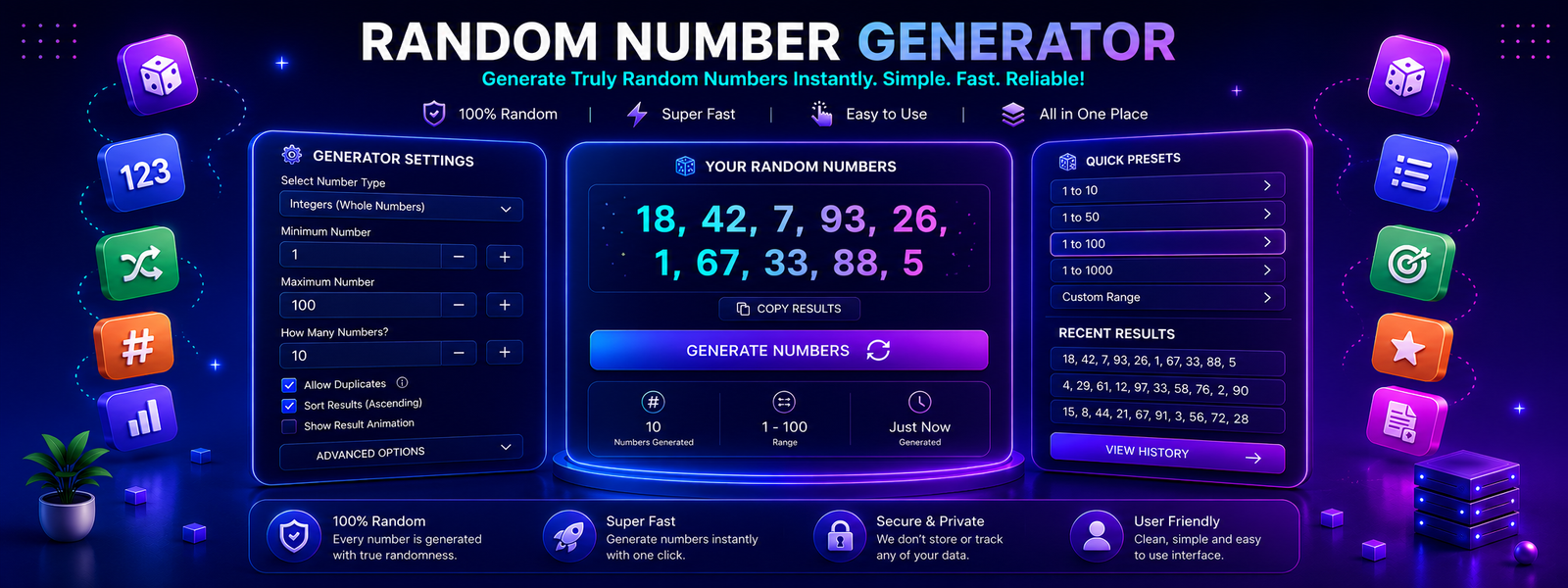
Every integer from the minimum through the maximum is eligible. Furthermore, duplicate values can appear when unique mode is off, whereas unique mode prevents repeats within the current generated set.
Each generated number appears at most once. Therefore, the requested quantity cannot exceed the total integers in the range.
In contrast, sorting changes only the display order after generation; it does not alter which values were selected.
Create a bounded random-number set in three simple steps.
First, enter the lowest and highest allowed integers. Negative numbers are supported.
Next, request up to 100 values and decide whether results must be unique or sorted.
Finally, select Generate numbers, review the result, and copy the list if needed.
Specifically, the tool requests unsigned 32-bit values from the Web Crypto API to implement rejection sampling. It rejects values beyond the largest evenly divisible limit and then maps the accepted value into the requested inclusive integer range.
This rejection step avoids the small distribution imbalance that can occur when a random source is mapped using remainder arithmetic alone. Consequently, every eligible integer receives an equal probability of selection.
The minimum and maximum are both possible outcomes.
For example, for a range from 10 to 15, there are six possible integers: 10, 11, 12, 13, 14, and 15. Requesting three unique values might produce 10, 13, and 15.
In addition, inputs must be whole numbers. Minimum cannot exceed maximum, quantity must be 1–100, and unique quantity cannot exceed range size.
Use bounded random integers for ordinary selection, practice, and testing tasks.
For instance, select turn order, a starting player, or a challenge number with a random integer generator.
Similarly, create small integer sets for demonstrations, worksheets, and testing using a random number picker.
In fact, choose numbered items or tasks easily when you generate random numbers with a number generator online.
Yes. Specifically, both boundaries are inclusive and can appear in the generated results.
Yes. In fact, enter a negative minimum alongside any valid maximum that is equal to or greater than it.
Duplicates are allowed by default because each draw is independent. However, enable Require unique numbers when every value must be different.
No. This browser utility is not independently audited or certified for regulated gambling, legal drawings, or security tokens.
Without exception, this widget generates and displays results inside the current browser page without sending or saving them.
Explore more free browser utilities from Tool Radar 360.
Choose the appearance you prefer. We’ll remember your selection across Tool Radar 360.
You can change this anytime from the header.